The problem
I wanted a phone number that answered as me. Not a chatbot on a website, not a Discord bot, a real E.164 number that anyone could dial and get an intelligent voice on the other end. That became Dyx: +1 (484) 270-7074, live at voicemail.kaushik.cv, wired up so callers get a conversation instead of a beep.
The whole thing lives or dies on one number: perceived latency to first spoken word. Humans notice a conversational gap at about 300ms. They start feeling awkward at 500. Past a second, they think the line dropped. My budget was 700ms end-to-end, p95, from "caller stops talking" to "caller hears the first phoneme of the response."
That number is the whole post. Everything else is a consequence of it.
The naive first approach
The obvious 2026 answer is a single-model speech-to-speech loop. Gemini Live does this. GPT-4o Realtime does this. You skip the STT and TTS boxes entirely. Audio goes in, audio comes out, turn detection is native to the model, and the vendor benchmarks quote 200-300ms end-to-end. It's the same architectural shift going from separate embedding-plus-reranker pipelines to a single joint retrieval model: fewer boxes, fewer hops, fewer places for latency to hide.
So I built it. LiveKit Cloud Agent, livekit-plugins-google realtime plugin, a Gemini API key vended from my CipherStack instance, one Python file, done.
Two things broke.
The first was auth. The Gemini keys in my CipherStack rotation are billing-enabled generative-language keys, they route just fine for generateContent, they route just fine for streaming text, and they hard-fail on the Live API with a 403 that reads like a permissions error but is actually a project-level API-enablement error. The Live API is gated behind a separate console toggle that my vended keys didn't have flipped on. The rotation vends the least-recently-used key, which meant every retry hit a different key with the same missing flag. I could have manually enabled Live on eight projects, but that defeats the point of a key vault.
The second was the tradeoff I hadn't priced. Even when Live works, you're betting the whole conversation on one model handling STT, LLM reasoning, and TTS. If the model has a bad moment, hallucinates the transcript, picks the wrong voice affect, stalls, you have no fallback, no observability point between stages, and no way to swap components independently. It's the IVF-PQ problem in a different domain: you buy latency by fusing steps, and you pay in stability.
I pivoted.
The decision
Three-stage pipeline: STT → LLM → TTS. Individual latency budgets per stage. Hosted inference at every step so I'm not babysitting a GPU. LiveKit Cloud Agents doing the audio transport and turn detection between them.
- STT: Deepgram nova-3 (streaming, endpointing at ~300ms of silence)
- LLM: Groq
llama-3.3-70b-versatile(hosted, streaming tokens) - TTS: Cartesia sonic-3 (streaming, first-byte latency optimized)
- Transport: LiveKit Cloud, WebRTC to the caller, gRPC/WebSocket to each provider
The tradeoff
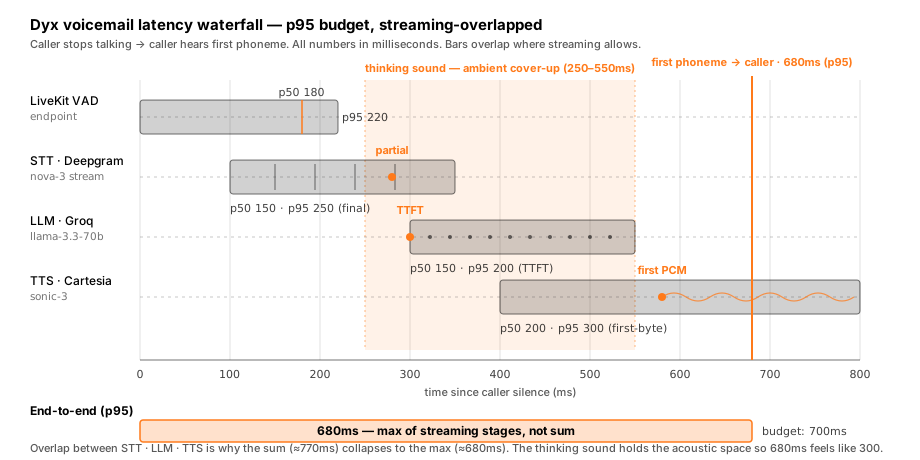
The honest way to write this is a table. Numbers below are directional, from Dyx in production over ~50 real calls, not a synthetic benchmark. Your mileage will vary with region, PSTN routing, and prompt length.
| Stage | Provider | p50 | p95 | Budget |
|---|---|---|---|---|
| Caller silence → endpoint detected | LiveKit VAD | 180ms | 220ms | 250ms |
| STT first token → final transcript | Deepgram nova-3 | 150ms | 250ms | 250ms |
| LLM TTFT (time to first token) | Groq llama-3.3-70b | 150ms | 200ms | 200ms |
| TTS first-byte audio | Cartesia sonic-3 | 200ms | 300ms | 300ms |
| LiveKit routing + network | WebRTC + PSTN gateway | 50ms | 100ms | 100ms |
| Total, streaming-overlapped | ~500ms | ~680ms | 700ms |
The stages overlap. That's the whole trick. Deepgram is streaming partial transcripts before the caller finishes talking. Groq starts generating tokens the instant a stable partial arrives. Cartesia starts synthesizing audio the instant the first LLM token lands. By the time the final transcript is confirmed, the LLM is often already three tokens in, and by the time the LLM's first sentence is done, Cartesia's first PCM frame is already flying to the caller's ear over WebRTC. The wall-clock latency is the max of the stages, not the sum, on the parts that can be overlapped.
At 2M docs, HNSW was the right index. On a voice agent, streaming with backpressure between every stage is the same shape of decision: pay in coordination complexity, buy stability at every hop.
Implementation notes
A few things that mattered more than the model choices.
LiveKit's pipeline abstraction did the right thing by default. The AgentSession API composes STT/LLM/TTS as pluggable components and handles the streaming stitchwork: partial transcripts get forwarded to the LLM plugin, streamed tokens get chunked into TTS-friendly sentences, generated audio gets pushed to the caller's WebRTC track. I did not write any of the plumbing. I picked components and set knobs.
# The whole pipeline. Genuinely.
# Every knob here was picked for latency, not quality.

from livekit.agents import AgentSession, Agent
from livekit.plugins import deepgram, groq, cartesia, silero

session = AgentSession(
    stt=deepgram.STT(
        model="nova-3",
        interim_results=True,           # start LLM on partials, not finals
        endpointing_ms=300,              # aggressive; retune per caller
        smart_format=True,
    ),
    llm=groq.LLM(
        model="llama-3.3-70b-versatile",
        temperature=0.6,
        # Groq's TTFT is the win, 150ms p50 for a 70b model is absurd.
    ),
    tts=cartesia.TTS(
        model="sonic-3",
        voice="a-neutral-warm-voice-id",
        # sonic-3 streams first PCM frame at ~200ms, not ~800ms like older models.
    ),
    vad=silero.VAD.load(),               # local, no network hop for turn detection
)

await session.start(agent=Agent(instructions=SYSTEM_PROMPT), room=room)
That's it. Ninety percent of the "latency work" was picking providers whose streaming primitives compose without buffering surprises, then setting endpointing aggressively enough that turns actually flow.
The endpointing knob is where p95 lives. Deepgram exposes an endpointing_ms, how long a silence to wait before declaring the caller's turn over. Set it too high (600ms) and the conversation feels sludgy no matter how fast the rest of the pipeline is. Set it too low (150ms) and you cut people off mid-thought. 300ms was the sweet spot for phone-call cadence; a video-call agent would want closer to 500 because people pause differently on video. This is the closest analogue to nprobe in a vector index: one number that dominates the tail.
Groq is the load-bearing choice. Llama-3.3-70b on Groq's LPUs runs at ~300 tokens/second with ~150ms TTFT. The same model on a hosted-GPU provider (Together, Fireworks) runs at ~50 tokens/second with 400-600ms TTFT. That difference is the whole latency budget of a slower stage. I did not want to run a 70b model on my own GPUs for a personal voicemail line, and Groq made the "hosted, cheap, fast enough" corner of the tradeoff space actually livable.
What surprised me
Perception is not latency.
I spent a week tuning the pipeline down from 900ms p95 to 680ms p95, and it moved the needle less than a two-line change I made afterward: playing a quiet, barely-audible thinking sound, background typing audio at low volume on a loop, the instant Deepgram fired its final transcript. The sound holds the acoustic space while Groq is generating tokens and Cartesia is synthesizing the first frame. Callers who tested Dyx before and after the thinking sound consistently rated the "after" version as feeling faster, even when the actual wall-clock latency was identical.
The human brain treats silence as "did the line drop." It treats ambient noise as "someone is preparing to speak." Fill the void and 700ms starts feeling like 300, because you've moved the perceived clock from "silence-to-speech" to "sound-to-speech." Every phone system in history has known this. Hold music, hold beeps, keypress feedback tones. I got to rediscover it on a personal project.
If I'd known that going in, I would have built the thinking sound before I optimized the pipeline. The perceptual lift per hour of work was 10x higher than the technical lift.
What I'd do differently at 10x scale
At one caller, this pipeline is fine. At a hundred concurrent, the trade flips.
The path I would take:
- Gemini Live once the API access materializes. The single-model speech-to-speech architecture is genuinely faster when it works, and the observability tradeoff matters less when you have call recordings to review offline anyway. The 200ms ceiling is not fictional; it's just gated behind a console toggle I didn't want to babysit across a rotation of vault-vended keys.
- A distilled S2S model. Kyutai's Moshi runs speech-to-speech at ~200ms on a single GPU, weights open. At my scale that's over-engineering; at a hundred concurrent callers, the economics of a self-hosted 7B S2S model start beating three hosted providers on an aggregated bill.
- Per-caller endpointing. Some people pause a lot mid-sentence. Some people talk over each other. Static 300ms endpointing is the vector-search equivalent of a single global
nprobe, it works on average and thrashes at the tails. A learned endpointing model that adapts to each caller's cadence would move p95 down another 100ms without cutting anyone off. - Move the "thinking sound" into the pipeline as a first-class primitive. Right now it's a hack triggered on transcript-final. It should be a state machine driven by pipeline events, with different sounds for "processing your question" vs. "generating a long response" vs. "I'm actually stuck." The perception knob deserves the same engineering attention as the latency knobs.
The meta-lesson: the naive architecture (single-model realtime) is right for the scale it's built for, and the pipeline architecture is right for the scale I'm at. IVF-PQ is the right answer at 200M vectors and the wrong answer at 2M. Gemini Live is the right answer at ten thousand concurrent callers and the wrong answer at one hobbyist with a rotation of API keys that don't have the right flag flipped. The engineering discipline is being honest about which regime you're in.
See also
- HNSW or IVF-PQ at 2M documents, the same shape of decision, in a different domain. Fuse steps for latency vs. keep them separable for stability.
- An LRU key-rotation state machine for a personal credential vault, the vault the Dyx pipeline pulls Gemini/Groq/Cartesia keys from.
- Guard-rails every personal AI should have, the six protocols I bolted on top of this pipeline before I was willing to leave the number up.
Other interactive playgrounds on this site:
- CipherStack: an LRU key-rotation state machine, the upstream vault whose ~2ms vend latency sits inside the Dyx budget as a rounding error.
Dyx is live at voicemail.kaushik.cv. Or just call +1 (484) 270-7074, it'll pick up. More on it on the projects page.